Namibian Mining News The Professional Mining Journal




Related Articles
Africa’s vast uranium deposits are transforming the continent into a critical battleground for global powers rushing to secure nuclear fuel. Driven by surging reactor demand, persistent supply-security anxieties, and a swelling wave of resource nationalism, international players are aggressively competing for access to the continent’s rich reserves.
While Kazakhstan and Canada continue to dominate the sector holding a combined 52% of globally identified resources alongside Australia Africa commands several of the world’s next premium resource bases. Namibia leads the continental pack, ranking fourth globally with 497,900 tonnes of identified resources, followed closely by Niger at 336,000 tonnes and South Africa at 320,900 tonnes. Emerging frontiers in Botswana and Tanzania add further depth to Africa’s long-term supply pipeline.
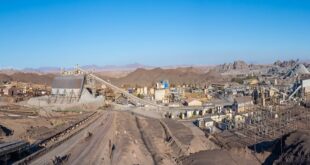
Namibia, however, has firmly established itself as the crown jewel of African production. Now ranking as the world’s third-largest uranium producer behind Kazakhstan and Canada, the southwestern African nation saw record output top 10,000 tonnes of $U_3O_8$, commonly known as yellowcake. Production climbed from 5,612 tonnes in 2022 to 7,333 tonnes in 2024, according to the World Nuclear Association, with data from early 2026 showing a sustained 22% year-on-year surge as Paladin Energy aggressively ramps up its Langer Heinrich mine toward maximum capacity.
This soaring production profile has turned Namibia into a magnet for foreign exploration capital, though it comes with immense geopolitical entanglement. Capital expenditure in the country skyrocketed from $11 million in 2020 to an expected $75 million, backing over 340,000 meters of drilling. Yet much of this infrastructure is already tethered to Beijing; the massive Husab mine is operated by Swakop Uranium backed by China General Nuclear Power Group while the historic Rössing mine is controlled by China National Uranium Corp.
“Western utilities are increasingly waking up to the reality of China’s structural lock on Namibian supply,” said an independent nuclear fuel market analyst. “As primary assets like Husab and Rössing channel yellowcake directly eastward, the runway is narrowing for Western buyers to secure the remaining uncommitted tier-one volumes.”
The race to secure alternative African supply routes has intensified following a dramatic collapse of Western influence in Niger. Once a reliable bedrock of French nuclear power, Niger has rapidly shifted from a core supplier to a high-risk zone. Political instability following a July 2023 military coup crippled local chemical supply lines, forcing a temporary halt to yellowcake production at the flagship SOMAÏR mine.
The military government has since embarked on a sweeping overhaul of foreign mining agreements, aggressively clawing back domestic control. In mid-2024, Niamey revoked French state-backed Orano’s permit for the massive Imouraren deposit and canceled Canada-based GoviEx’s rights to the Madaouela project, culminating in the outright nationalization of SOMAÏR in June 2025.
“Niamey is fundamentally rewriting the rulebook for foreign extraction,” a Dakar-based geopolitical risk consultant noted. “By rescinding legacy permits and nationalizing key assets, the junta is sending a unambiguous message: historical colonial concessions are over, and the resource will be leveraged for maximum sovereign or alternative geopolitical alignment.”
This vacuum has cleared a path for Moscow. Reports indicate deep anxieties in Paris over a pending deal for Niger to sell approximately 1,000 tonnes of yellowcake to Russia’s state nuclear corporation, Rosatom, for an estimated $170 million even as both parties maintain public denials.
Consequently, Western nations, particularly France, are being forced to pivot. With Niger turning hostile, Paris is actively recalibrating its African supply lines, shifting its focus toward more stable jurisdictions like Botswana, Malawi, and the uncommitted pipeline in Namibia, where Deep Yellow’s Tumas and Bannerman Energy’s Etango projects represent the next wave of development.
Meanwhile, South Africa sits quietly on a massive, deep resource base that could rewrite the continental dynamic if sustained high prices persist. Unlike its neighbors, South Africa’s uranium is primarily extracted as a by-product of its ultra-deep gold mines, such as Harmony Gold’s Moab Khotsong underground operation. If uranium prices continue their upward trajectory, the reprocessing of historical gold tailings and by-product circuits could quickly transform South Africa from a sleeping giant into a vital, liquid supplier to a starved global market.