Namibian Mining News The Professional Mining Journal



Related Articles
Mining’s decarbonisation challenge is increasingly being tackled at the level of system design. For Weir, the path to lower emissions and reduced water use lies not in optimising individual pieces of equipment but in fundamentally rethinking how processing circuits are built. That philosophy is shaping the group’s broader strategy, where sustainability acts as the organising principle rather than a secondary objective.
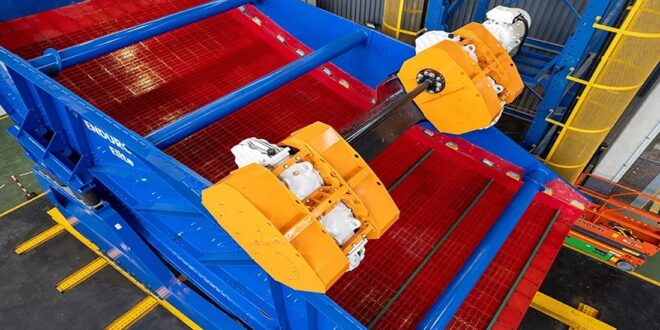
Weir’s Regional Engineering Director EMEA at Weir, Christian Stehle noted that the company’s approach is structured but holistic. “That promise plays out in four main areas of energy, water, waste and digital, all underpinned by a strong safety culture,” explained Stehle. The most immediate gains, according to Weir, sit in comminution, the most energy-intensive stage of mining. Instead of refining traditional grinding methods, the company is advocating for alternative flowsheets that reduce reliance on conventional tumbling mills altogether. “At Weir, we are promoting ‘non-traditional’ flowsheets built around high pressure grinding rolls, large ENDURON vibrating screens, coarse particle flotation and stirred mills to cut back on conventional tumbling mills. If you can do that in your flowsheet, then you use less water and significantly less energy compared to tumbling mills,” said Stehle.
The potential impact is substantial. A study conducted by Weir and independently assured by SLR Consulting indicates that switching to these newer technology combinations could reduce energy consumption by 40% and cut CO2e emissions by up to 50%. Rather than incremental efficiency improvements, this represents a step change in how processing plants consume power. These concepts are already being implemented in live projects. Weir has secured an order for high pressure grinding rolls at Ivanhoe Mines’ Platreef project in South Africa, demonstrating how alternative comminution technologies are being deployed at scale. In Namibia, the company is also supplying a crushing and screening plant for a gold copper operation, incorporating ENDURON crushers and vibrating screens designed to improve efficiency while lowering total cost of ownership.
Beyond energy, water stewardship and waste reduction form the next layer of the strategy, particularly in how tailings are managed. “For example, we have developed the Terraflowing dewatering solution which enables discrete tailings fractions to be handled in a way to produce an engineered paste product. By separating the tailings stream into discrete fractions, operators can handle them in different ways, providing a higher level of flexibility in the way they dewater their tailings, while still having a consistent end product.” explained Stehle. Further efficiencies are being captured through improved classification and separation. Technologies such as the CAVEX CVD hydrocyclone range help reduce recirculating loads and unnecessary regrinding, lowering both water and energy demand across the circuit. Even wear parts, often overlooked in sustainability discussions, are being reframed as a key lever.
Extending component life reduces material consumption and downtime, delivering both environmental and operational benefits. “If you can make your parts last longer, that in and of itself is also a sustainability improvement, because you are using fewer resources to make new parts. Also, there’s a commercial advantage for the customers because their equipment runs longer with less downtime,” concluded Stehle. Overlaying these engineering changes is a growing digital capability. Through acquisitions including Motion Metrics, Micromine and Fast2Mine, Weir is building an integrated data ecosystem that connects pit to plant, enabling smarter, more predictive operations.