Namibian Mining News The Professional Mining Journal



Related Articles

The scale of illegal sand extraction in Namibia remains uncertain, raising questions about the effectiveness of environmental oversight as unregulated borrow pits threaten communities, livelihoods and landscapes. Figures presented to the National Assembly reveal that the Ministry of Environment, Forestry and Tourism received approximately 56 applications for environmental clearance certificates (ECCs) over three years, while only 15 cases of illegal sand mining had been reported.
Environment, Forestry and Tourism Minister Indileni Daniel disclosed the figures in response to a question from parliamentarian Rodrick Likando, noting that applications were concentrated mainly in the northern communal areas and central Namibia. Kunene, Hardap, Kharas, Zambezi, Omaheke, Kavango West and Kavango East recorded particularly low application numbers. The figures do not establish how many sand and gravel extraction operations are active nationwide, how many hold valid environmental clearances or how many are operating unlawfully. However, the limited application numbers across several regions raise concerns about compliance monitoring and the authorities’ ability to establish the full extent of extraction activities.
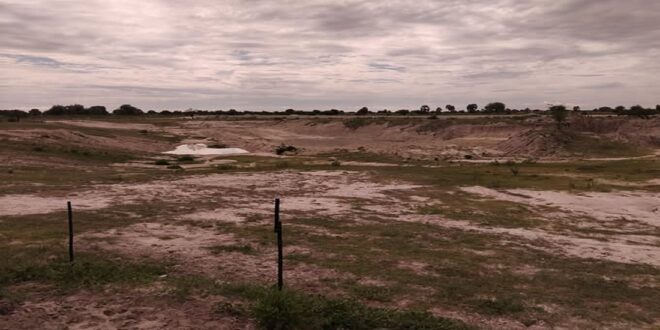
The environmental stakes are particularly pronounced in the north-central regions of Oshana, Oshikoto, Ohangwena and Omusati, where Daniel identified sand and gravel extraction as a persistent concern. Uncontrolled extraction can leave dangerous, unrehabilitated borrow pits that expose communities to physical hazards and place pressure on surrounding environments. Daniel warned that lives had been lost, particularly among children playing in abandoned pits, although she did not provide details of the fatalities or identify the affected locations.
“Lives have been lost, especially children playing in unrehabilitated borrow pits, hence our reasons to enforce strict compliance,” said Daniel. The government has taken enforcement action, with the Office of the Environmental Commissioner working alongside law enforcement agencies to close sites where illegal sand mining was taking place. Authorities have also issued compliance orders to halt unauthorised activities. Daniel acknowledged, however, that government and private sector institutions continued to undertake activities requiring environmental clearance without first obtaining the necessary certificates.
She added, “This is a very serious violation of the Environment Management Act.” The admission points to a compliance challenge extending beyond informal extraction, raising questions about adherence to environmental requirements across institutions involved in infrastructure development and other activities that rely on sand and gravel. These materials remain essential to road construction, housing and broader infrastructure development, placing pressure on authorities to balance demand for construction inputs with environmental protection and public safety.
Rehabilitation is another area of concern. The government, working with stakeholders including the Roads Authority, has rehabilitated more than 30 borrow pits, mainly in northern Namibia. Some of the sites date back to before independence, underscoring the long-term consequences of extraction sites left without adequate rehabilitation. To strengthen oversight, the Ministry is developing stand-alone Sand and Gravel Extraction Regulations intended to improve the management and control of mining activities. Daniel did not provide a timeline for their finalisation or implementation. The Office of the Environmental Commissioner has also undertaken regional awareness campaigns and monitoring activities, including inspections conducted across individual regions, to improve compliance.
Under the current enforcement framework cited by the minister, anyone undertaking listed activities without an ECC faces a fine of up to N$500,000, imprisonment for up to 25 years or both upon conviction. The effectiveness of these measures will depend on more than the severity of the penalties. Reliable data on active extraction sites, consistent inspections, enforcement against non-compliant operators and timely rehabilitation of abandoned pits will be critical to closing gaps in oversight. Until the government establishes a clearer picture of the number and location of extraction operations, the 56 applications and 15 reported illegal cases offer only a partial view of the challenge.