Namibian Mining News The Professional Mining Journal



Related Articles
Andrada Mining’s latest drilling at its Lithium Ridge Project in Namibia shows that the lithium on the property reaches further than previously understood, with rich results from several rock bodies including newly identified ones that sit outside the main belt of mineralisation the company has been following.
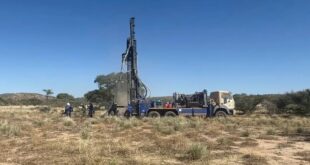
The fifth batch of diamond drilling results, a method that extracts solid rock cores for laboratory analysis, covers 23 holes that successfully intersected mineralisation. The cores confirm that the lithium bearing rock continues downwards and thickens in places within the targeted pegmatite swarms. Pegmatites are coarse grained rocks that can host lithium and a swarm is simply a cluster of them. The results also point to a broader commercial opportunity, because tin and tantalum are present alongside the lithium.
The Lithium Ridge Project is being advanced under a Stage 1 earn in agreement with SQM International, one of the world’s leading lithium producers. Lithium grades are reported as a percentage of lithium oxide, written as Li₂O, which is the industry’s standard yardstick. A higher percentage means richer rock. Each result below describes a stretch of rock cut by a drill hole, its length in metres, its average grade and how far down the hole it begins.
One of the strongest results came from hole LRD045, which cut through 34.90 metres of rock averaging 1.02% Li₂O, starting 184.42 metres down the hole. Within that stretch, a richer section of 6.22 metres averaged 1.67% Li₂O. Hole LRD060 returned 10.66 metres at 1.13% Li₂O starting just 0.90 metres down, which means the mineralisation begins almost at surface, and generally shallow rock is cheaper to reach. A richer 4.79 metres inside it averaged 2.04% Li₂O. Hole LRD042 intersected 9.03 metres at 1.64% Li₂O from 63.83 metres, including 5.44 metres at 1.84% Li₂O. Hole LRD066 recorded 11.35 metres at 1.16% Li₂O from 34.16 metres, including 4.64 metres at 1.79% Li₂O.
According to Andrada’s Chief Executive Officer, Anthony Viljoen, the results point to further exploration upside across the licence. “This fifth batch of results demonstrates the presence of high-grade intersections confirming that we are still uncovering the full potential of the Lithium Ridge licence. Multiple pegmatites in this batch have returned intersections exceeding 1.5% Li₂O. These results also confirm that newly identified pegmatites beyond the main mineralised trend at Lithium Ridge also contain substantial lithium mineralisation. This highlights the upside potential that remains to be explored across the licence,” said Viljoen.
The drilling shows that mineralisation runs from near the surface to depths of up to 275 metres. Importantly, holes LRD064, LRD066 and LRD072 confirmed consistent high grade mineralisation within a newly identified pegmatite outside the established Lithium Ridge trendline. Earlier grab sampling, which involves collecting selected rock samples from the surface, had given only an initial hint of lithium potential at these targets. Drilling has now shown that the pegmatites continue underground and retain significant lithium grades. The company will investigate these additional targets during the next stage of development, which could widen the area it explores well beyond its current understanding of the system.
The programme is also helping Andrada refine its detailed digital model of the geology and establish the limits of the mineralised pegmatite swarm. Six holes, namely LRD058, LRD065, LRD076, LRD082, LRD095 and LRD101, either missed significant pegmatite or returned results below the company’s minimum reporting threshold. These holes still add value, because knowing where the mineralisation stops sharpens the boundaries of the deposit and builds the geological confidence needed for any future resource estimate.
Lithium may not be the only source of revenue. Tin and tantalum mineralisation is widespread across the pegmatite bodies, although the intersections so far are narrow. Hole LRD061 returned 0.25 metres at 1.03% tin and 227 parts per million of tantalum, which equates to roughly 0.02%. Hole LRD074 returned 0.95 metres at 0.57% tin, and hole LRD045 returned 0.36 metres at 604 parts per million of tantalum or roughly 0.06%. The three metals could strengthen the project’s economics by giving it several commodities to sell, although further metallurgical testwork and economic evaluation will be needed to establish how much each would contribute. Spodumene, a lithium bearing mineral, remains the primary source of lithium in the reported intersections and the mixed metal profile gives Andrada a chance to draw on its existing processing expertise as it considers how best to maximise recovery.
Investors should note how the figures are measured. The holes were drilled at inclined angles of between 45 and 75 degrees so that they cut the pegmatites as close to square on as practicable. Even so, the reported lengths are apparent widths rather than true thicknesses, so the actual thickness of the rock bodies will differ. The drilling, logging and sampling programme was supported by independent laboratory analysis and comprehensive quality assurance and quality control procedures. As exploration progresses, the combination of rich lithium intersections, continuity at depth and mineralisation beyond the main trend could give the company a broader basis for judging the project’s resource potential. The immediate focus for Andrada is on defining these mineralised systems further, deepening its metallurgical understanding and determining how lithium, tin and tantalum can be turned into a commercially viable development.