 Namibian Mining News The Professional Mining Journal



Related Articles
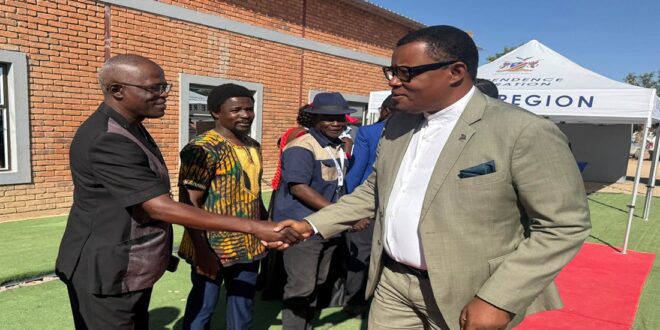
Selling goats to buy into a mine may sound unconventional but Kunene Governor Vipuakuje Muharukua wants residents in Namibia’s north-west to consider exactly that. His proposal to pool community assets into a shared mining investment challenges the traditional model in which local people provide land and labour while ownership and financial returns remain elsewhere.
Muharukua wants residents to explore collective investment in mineral exploration, giving communities a direct stake in mining ventures rather than relying on employment and corporate social responsibility (CSR) initiatives. Speaking at the Kunene Mining Summit in Opuwo, Muharukua said he would convene meetings with residents after the event to discuss how they could mobilise resources towards a shared mining investment.
“Wealthy people invest in exploration activities and have a stake in those businesses. I want an avenue through which the people of the Kunene region can buy into those exploration activities and become owners of those businesses,” said Muharukua. His proposal centres on pooling relatively modest assets to build collective capital. Using livestock as an example, he asked whether 500 people contributing five goats each could generate N$5 million through sales.
Muharukua said, “From the five goats, we could have one mine owned by the people of the Kunene region.” The ambition reflects a wider challenge facing resource-rich communities: translating mineral development into lasting local economic participation. While mining operations can create jobs and fund community projects, these benefits do not necessarily give residents an ownership stake in the assets generating the returns.
He argued that mining must also account for the livelihoods displaced by industrial activity, particularly grazing land. “Where these mines operate, there was grazing. If grazing is gone, it must be supplemented, not through CSR but through ownership,” added Muharukua. However, turning community contributions into a viable mining venture would require more than raising capital. Mineral exploration carries substantial financial risk and investors can lose their contributions if projects fail to establish commercially recoverable deposits.
Namibia Investment Promotion and Development Board mining expert Andreas Salom cautioned against directing community funds into high-risk exploration before establishing a sound investment framework. He pointed to crowdfunding initiatives supporting infrastructure in countries including Ethiopia and Botswana, suggesting that Kunene could first consider lower-risk projects.
A pilot built around a verified shared-use asset, such as water infrastructure or local enterprise services, could help test community participation while establishing transparent financial controls and accountability. Any mining investment model would also need clear ownership arrangements, independent financial oversight, reliable information for contributors and provisions for environmental rehabilitation.
Muharukua intends to take the initiative to next year’s Mining Indaba in Cape Town, potentially presenting a community-backed investment plan to industry stakeholders. The proposal’s significance will depend on whether the region can convert its collective-resource ambition into a structure that protects residents’ livelihoods while giving them a credible stake in mining’s long-term returns.
