Namibian Mining News The Professional Mining Journal



Related Articles
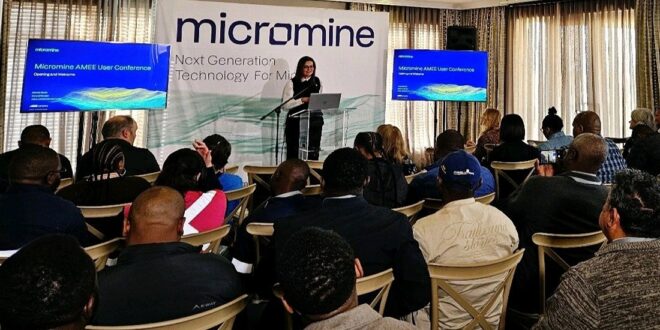
The conversation at the Next Generation Technology for Mining User Conference, running from 5 to 6 August 2026, opened with a clear signal that the industry is no longer cautiously exploring digital tools but actively reshaping operations around them. From geology to production, speakers on the first day set out a narrative anchored in immediacy, integration and measurable outcomes.
Micromine’s General Manager Africa, Middle East and Europe, Michelle Beetar set the tone by highlighting both the composition of the room and the direction of travel. “75% of the people using our software includes geologists and that tells you where the transformation is happening,” said Beetar. She emphasised that both open pit and underground operations are being redefined through connected systems that bring data closer to decision making. “From geology to production we are seeing a complete shift and Nexus is about bringing artificial intelligence and automation into that flow in a practical way,” noted Beetar.
The technical depth behind this shift was further unpacked in a session led by Paula Mierzwa of the Addison Group, titled ‘How Certain Are Our Ounces’. Her focus on assessing resource uncertainty through conditional simulation brought sharper context to the role of modelling in modern mining. “The conversation is not about choosing one over the other but understanding how each method supports better decision making,” noted Mierzwa, as she explored the balance between simulation and kriging. Her emphasis remained firmly on risk mitigation. “If we can simulate outcomes before we commit in the field we reduce uncertainty and improve confidence across the value chain,” she added, pointing to case study work that demonstrated how refined modelling leads to more reliable resource estimates.
Real world application followed with a focused look at digital mine planning. In a session on the digital mine planning journey with Micromine Spry, Abdul Momade of Vulcan Mozambique shared insights from the Moatize coal mine. “We needed faster planning and more innovative solutions to address the limitations we face in mining and this is where the system is delivering,” said Momade. Automated scheduling and rapid scenario generation are already changing how the mine operates. “The flexibility and robustness of the software allow us to optimise constraints and that is translating into real business impact and increased production,” explained Momade.
Momentum carried into discussions around scheduling and execution. Jonathan Dzah of AngloGold Ashanti presented on the benefits realised so far from using Micromine Alastri, with a strong emphasis on the new user experience. “We have reduced scheduling time by around sixty percent and that is a major shift for us,” said Dzah. Beyond speed, he pointed to stronger alignment between teams and improved operational clarity. “Better visualisation is helping us bridge the gap between what happens in the office and what happens on the ground,” said Dzah. He also highlighted the growing role of data driven planning. Dzah noted, “We are now using historical data to test scenarios more rapidly and that flexibility is improving the quality of our decisions.”
The day also broadened into a wider systems perspective through discussions on connected mining. Presentations covering integrated platforms including Fast2Mine, Advance, Pitram and Motion Metrics reinforced the role of technology in building a modern, responsive mine. These systems are increasingly working together to deliver real time visibility, improved safety oversight and tighter operational control, further strengthening the link between planning and execution.
Across all sessions, a consistent theme emerged. Mining companies are moving beyond digital experimentation towards embedded systems that deliver speed, clarity and resilience. The integration of artificial intelligence, advanced modelling and automated planning is not only improving operational efficiency but also redefining how decisions are made across the mine lifecycle. As the conference continues, the focus is expected to deepen on how these technologies can be scaled and sustained. Day one has already made it evident that the future of mining will be shaped by those who can seamlessly connect data, people and processes into a unified operational strategy.